

HOME || CEMETERIES || SCAVENGER HUNT || MAP || MERCHANDISE
Capt. John I. Klum
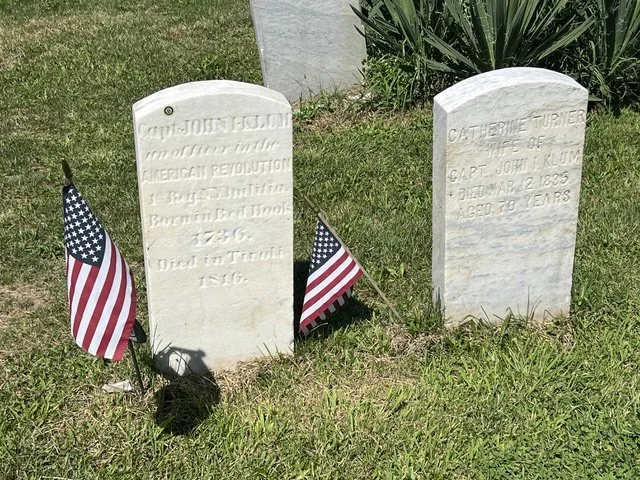
Born 17 July 1736 Died 15 September 1816
Old Red Church cemetery, Tivoli. A white marble tablet with curved top marked with a Revolutionary War stick marker about six or seven rows north of the church near some yuccas.
Visitors to West Point marvel at the links of the chain that was forged and placed across the Hudson River in an attempt to stop British forces from navigating that waterway during the American Revolution. Captain John (or Johannes) Klum had a hand in its placement, according to records in the New York State Archives and summarized in the Capt Johannes Klum Family & History entry. And yet there are some questions and ironies, of course, surrounding his life.
Klum was born July 17, 1736. There is a baptism record for Johan Philip Klum, the son of George and Anna Morie (probably Marie) Schnyder Klom and baptized in Reyn Beeck (of which Red Hook was a part) on November 1st, 1736 and witnesses to his baptism were Philip Klom and Getruy Schnyder. Perhaps this is the same Johannes Klum who eventually became a captain in the Revolution. Maybe there were two Johannes Klums born in 1736 in Rhinebeck: a Johannes P. and a Johannes I. More digging is required to know for sure.
The U.S. Revolutionary War Burial Index indicates that a Capt. John I. Klum who (other than the middle initial of I.) matches the details of Johannes Klum, is interred at the cemetery in Madalin (Tivoli), New York, now known as the Old Red Church cemetery.
Klum’s service in the American Revolution began when he was a 1st Lieutenant in the 1st Regiment of Dutchess County militia from Rhinebeck commanded by Capt. Martin Hoffman’s under the command of Col. Peter TenBroeck. Klum was promoted to captain on March 18th 1778 while the unit was under Col. Morris Graham. This regiment saw active service from 1775 until the close of the war.
Johannes Klum was stationed at the Highlands and assisted in laying the great iron chain across the Hudson River to prevent the British ships from coming up. A copy of his payroll is in the State House at Albany. Another source verifies the date of Klum’s promotion to captain and notes that John Hermans was his 1st Lieut. and Andres Hermans his 2nd.
Here is a tragic irony: Klum may have enslaved people. According to the 1790 census, a John Klum of Rhynbeck (later Red Hook) was the head of a household that numbered 14, with four being enslaved, and in the 1800 Census, John Klum was the head of a ten-member household, with six people enslaved. And yet, Klum fought for the liberty of Americans from the British. Sadly, this dichotomy was one that patriots such as George Washington and Thomas Jefferson also exhibited. Thus while we can admire their service to the cause of freedom, we can mourn that they themselves denied the liberty of other humans in their own households.